AI assistants and chatbots
Answer customers and staff 24/7 on your website, email, WhatsApp and Viber from your knowledge base, and hand complex conversations to a human.
AI for business
We build AI solutions for companies in Montenegro, the Balkans and Europe: assistants, chatbots, document search and process automation. Everything runs on our own fine-tuned models, in a private EU cloud or on your servers, with no data sent to outside AI providers.
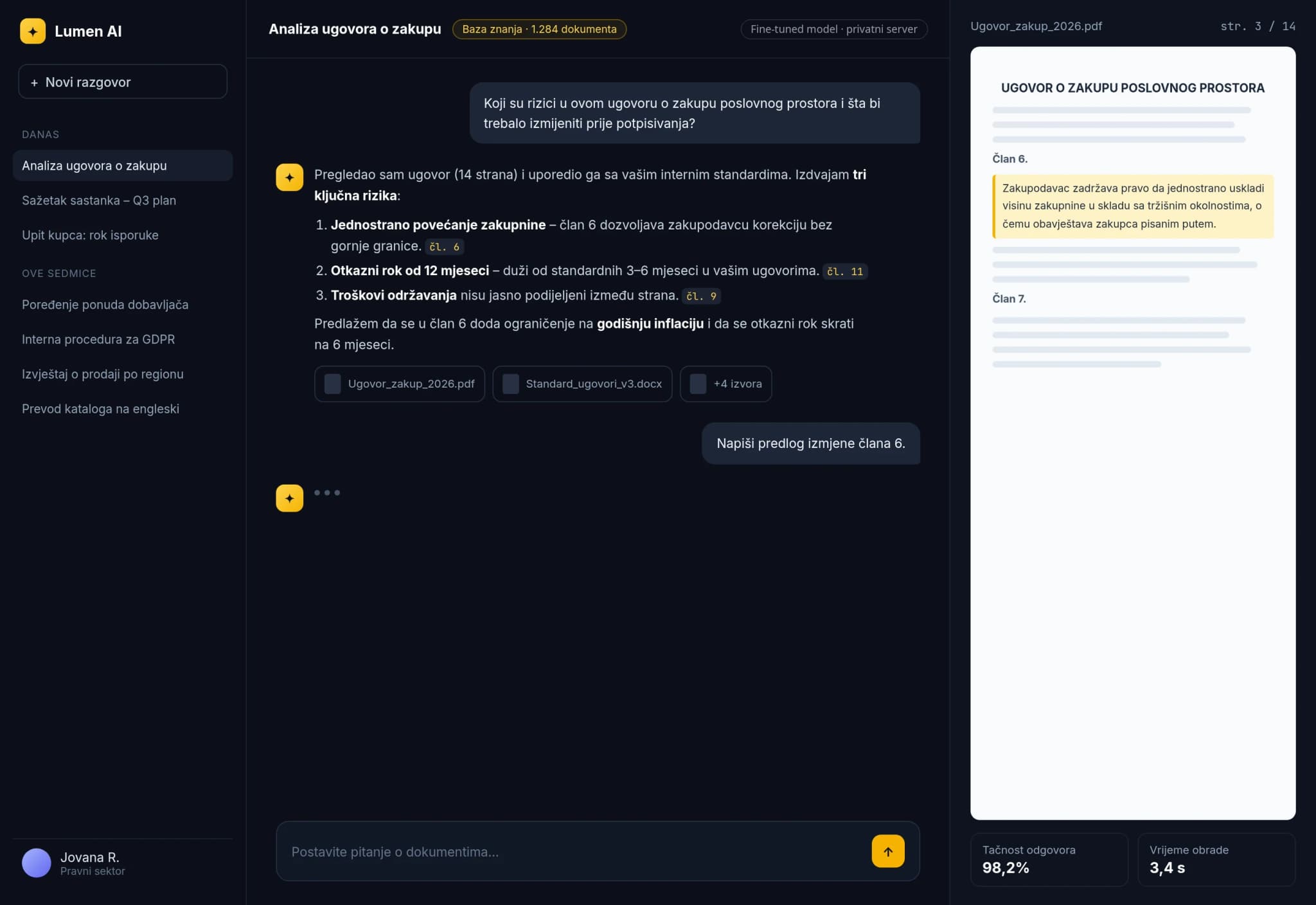
Cited answer · Policy, p. 14
Model runs on your server
Why AI
AI pays off where the same work is repeated hundreds of times a month. In most companies that happens in three places.
Opening hours, prices, order status, return policy. Your team answers the same things while customers wait outside office hours or give up.
Contracts, policies and manuals exist, but finding the exact clause or procedure takes time. New hires depend on colleagues who know where to look.
Data from emails, invoices, quotes and scans is retyped into the CRM, ERP or spreadsheets, with errors that are expensive to fix later.
What we build
Every solution runs on our own models, adapted to your industry and connected to the systems your team already uses.
Answer customers and staff 24/7 on your website, email, WhatsApp and Viber from your knowledge base, and hand complex conversations to a human.
Ask questions across contracts, policies and technical documentation and get answers that cite the document and page, with access rights respected.
AI sorts incoming email, extracts data from invoices and quotes, drafts replies and fills in your CRM or ERP.
Agents don’t just answer: they search your catalogue, create CRM enquiries, check status or book appointments within the rules you set.
Reading scanned documents and photos, detecting objects in images and processing visual content automatically.
We fine-tune models on your terminology and real examples and run them in our private EU infrastructure or on-premise.
How it works
We combine fine-tuned models with retrieval over your sources (RAG), so the AI speaks the language of your industry and answers only from verified data.
Documents, knowledge base, email, CRM and ERP are connected through secure integrations, keeping existing access rights.
Text, tables and scanned documents are cleaned, split into meaningful chunks and indexed for hybrid search.
A model tuned on your terminology finds the relevant passages and writes the answer or triggers an allowed action.
The user gets an answer citing the document, and uncertain cases go to an operator as a draft.
We track accuracy, user ratings and costs, and periodically fine-tune the model on new examples.
Use cases by industry
Same principles, different processes. These are the use cases we most often recommend after a discovery workshop.
Legal
A legal assistant that searches legislation, case law and internal matters and cites the source with every answer.
Real estate
An assistant that understands what a buyer describes in a sentence and turns it into a search, so agents receive qualified leads.
Tourism and hospitality
A multilingual assistant that answers guests about rooms, prices and availability and takes booking requests.
Transport and logistics
Automated handling of email and chat: ticket or shipment status, changes and complaints, with handover to an operator when needed.
Retail and e-commerce
An assistant that recommends products, answers about stock and delivery and helps your team process orders faster.
Finance and accounting
Reading invoices and statements, classifying documents and an internal procedures assistant, on-premise for sensitive data.
Case studies
Platforms in production that show what AI looks like when it works with real data and real users.

Kruna.ai
A legal AI assistant that answers from Montenegrin legislation and case law and cites the source with every answer.

DreamEstate
A tool-using AI assistant that turns plain-language requests into listing searches, plus computer vision for 360° tours.

BusTicket AIClient project
Automated email and chat support in four languages, with uncertain cases handed over to operators.
Packages
Starting development prices. You get the exact scope and a per-phase price in a written proposal after an intro call.
from €800one-off
For companies that want to automate answers to customers on their website.
Most popular
from €2,000one-off
An assistant adapted to your industry and connected to the systems you use.
from €5,000per project
For larger organisations, sensitive data and several connected systems.
On top of development there is a monthly cost for model hosting and maintenance, depending on usage and on whether the model runs in our EU infrastructure or on-premise. All pricing
Comparison
Off-the-shelf tools are quick to try, but with business data and integrations the differences get big.
| Criterion | ProCode in-house AI | SaaS chatbot | Public AI tools |
|---|---|---|---|
| Data stays in the EU or on your server | Yes | Partly | No |
| Model adapted to your industry | Yes | No | No |
| Answers cite your own documents | Yes | Partly | No |
| Integration with CRM, ERP and internal systems | Yes | Partly | No |
| Local languages and your terminology | Yes | Partly | Partly |
| On-premise deployment | Yes | No | No |
| Ownership of the solution | Yours | Subscription | None |
| Cost model | Build + maintenance | Per message or seat | Per seat |
Process
We work in short phases, so you see results early and decide based on real data.
Step 1 · 2–5 days
We map processes, pick where AI saves the most and agree how success will be measured.
Step 2 · 1–2 weeks
A working demo on your real documents and questions, so you see answer quality straight away.
Step 3 · 2–6 weeks
We fine-tune the model on your examples and connect it to your website, email, CRM and internal systems.
Step 4 · 2–4 weeks
Part of your team or customers uses the solution while we measure accuracy and refine answers.
Step 5 · ongoing
Launch, quality and cost monitoring, knowledge updates and periodic model fine-tuning.
Technology
From models to servers, we build and maintain everything ourselves. No dependency on outside AI providers.
Guide
AI solutions for business are no longer an experiment for large corporations. A company with ten people can automate customer replies or document search. This guide explains what such a project looks like, what it costs and what to watch out for.
An AI solution for a company is software that uses language models, retrieval and computer vision to do part of the work people do today: answer questions, find information, read a document or prepare a draft. Unlike public AI tools, a business solution works on your data, respects access rights and is connected to your systems.
It pays off most in repetitive processes with clear rules: customer support, internal knowledge bases, incoming document processing and lead qualification. AI doesn’t replace the team. It takes over the routine so people can focus on cases that need judgement.
In practice it looks like this: a customer asks about availability and price at 11 pm, and the assistant answers from the current price list and opens an enquiry in your CRM. Someone in accounting photographs an invoice, and the system extracts the supplier, amounts and dates and prepares a record for review. A lawyer asks about a limitation period and gets an answer with the article of law. None of this requires your team to change how they work, because AI runs inside the tools they already use.
When a company uses a public AI service, documents and customer conversations go to third-party servers, often outside the EU. For contracts, financial or medical data and client files, that is a risk many organisations simply cannot accept.
That is why we build complete in-house solutions. We use our own models, fine-tuned on your terminology and real examples, and run them in our private EU infrastructure or on your servers. You get predictable costs, control over your data and a model that sounds like your company.
There is a practical difference too. Public services change models, prices and terms regardless of your processes, so answers that were good yesterday may be different tomorrow. With an in-house solution you decide when the model is updated, and every new version passes the same tests on your questions before it reaches production.
Two techniques work together. RAG (retrieval-augmented generation) means the model searches your documents before answering and answers only from what it found, citing the source. When you change a price list or policy, you update the document and the assistant knows immediately.
Fine-tuning adapts the model itself: writing style, terminology and answer format. We usually use what you already have, such as past support replies, emails and internal guides. Together they produce an assistant that is both accurate and natural, and keeps hallucinations to a minimum because it answers from verified sources.
Quality depends more on data preparation than on model size. A large part of the work is cleaning documents, recognising tables and scanned pages, splitting text into meaningful chunks and running hybrid search that combines meaning with exact terms such as contract numbers or product codes. Finally we rerank the results, so the model only sees the most relevant sources.
The best first project is small, measurable and visible. Instead of “AI for the whole company”, pick one process where it is easy to measure how much time it takes today and after rollout. In the workshop we score processes against these criteria:
Typical strong candidates are answers to frequent customer questions, triage of incoming email, search across internal procedures and data extraction from invoices or orders. Once the first project shows results, the same foundations, meaning the model, indexes and integrations, are reused for the next process, so every following step is faster and cheaper.
We design every solution so the AI only sees what the user is allowed to see. Access rights are inherited from existing systems, traffic is encrypted and every action is written to an audit log. Personal data is processed in line with GDPR and local data protection law.
For banks, healthcare, law firms and public institutions we offer on-premise deployment, where the model, documents and indexes stay inside your network. We also help with hardware sizing, since mid-sized fine-tuned models run on one or two GPU servers.
Security also covers how the model behaves. We define what the assistant may do, which actions need human confirmation and which topics it declines. Before launch we test abuse attempts, such as requests for other people’s data or attempts to bypass the rules, and we repeat those tests with every model update.
Building an AI chatbot starts at €800, an assistant with integrations at €2,000 and an enterprise system at €5,000. On top of that comes a monthly hosting and maintenance fee that depends on usage and on whether the model runs with us or on your premises.
ROI is straightforward: how many hours your team spends on the process today, how many it will spend with AI and what a faster reply to a customer is worth. That is why we define metrics at the start and track them during the pilot, so you decide on scaling based on numbers from your own company.
To keep the investment safe, we split the project into phases with a clear outcome. After the prototype you know whether quality meets your expectations, and after the pilot you have real data on savings. Only then does it make sense to extend the solution to new channels, teams or processes.
FAQ
Answers to what business owners and IT teams ask most often before their first AI project.
It depends on scope. A website AI chatbot that answers from your knowledge base starts at €800. An AI assistant with a fine-tuned model, several channels and CRM or email integration starts at €2,000, and enterprise solutions such as company-wide document search or agents connected to multiple systems start at €5,000. There is also a monthly hosting and maintenance fee. After an intro call you receive a written proposal priced per phase.
We use our own language models, fine-tuned for each industry and client. They run in our private EU infrastructure or on your servers, so your data is never sent to outside AI providers. Alongside language models we build embedding and retrieval models, OCR and computer vision. We develop and maintain the full stack, from models to the application, ourselves.
Usually not. The assistant’s knowledge comes from documents you already have, such as price lists, manuals, contracts and policies, connected through RAG. For fine-tuning we use existing examples like past support replies, emails and templates. Larger datasets are only needed for specific tasks such as forecasting or image recognition, and even then we start with what you have and improve the system as data accumulates.
Yes. Models and data live in our EU infrastructure or on your servers, with encrypted traffic, role-based access and an audit log. We don’t send your data to outside AI services or use it for other clients. For banks, healthcare, law firms and institutions we offer on-premise deployment. Every solution is aligned with GDPR and local data protection regulations.
Yes, and that is where AI delivers the most value. We connect assistants to your website, email, WhatsApp and Viber, CRM and ERP systems, document management, calendars and internal databases via APIs or direct integrations. That way AI doesn’t just answer but creates enquiries, checks order status or books appointments. If your system has no API, we propose the safest way to exchange data before work begins.
Yes. Our models are fine-tuned on regional text, so they understand Montenegrin, Serbian, Bosnian and Croatian in Latin and Cyrillic script, including text typed without diacritics. The assistant replies in the user’s language and can switch to English, Russian or German mid-conversation. Your industry terminology is added through fine-tuning and tested against real questions so replies sound natural.
The assistant answers from your documents and cites the source, so every claim can be checked. When the sources don’t contain enough information, the model is set up to say so and offer contact with your team instead of guessing. For sensitive processes AI prepares a draft that a person approves. During the pilot we measure accuracy on real questions and refine the model before full launch.
You see a working prototype on your data after one to two weeks. A simple chatbot can be in production in two to four weeks, an assistant with a fine-tuned model and integrations in four to eight, and larger systems such as company-wide document search in two to three months. Phase timelines are set out in the proposal.
Most business assistants need one or two servers with GPUs, and smaller models or document search can run on a more modest setup. After the workshop we recommend an exact specification based on the number of users and document volume. We handle installation, configuration, monitoring and model updates, while the infrastructure and data stay in your network.
The solution built for you is yours, including the adapted model, indexes and application, under the terms of the contract. After launch, monthly maintenance covers accuracy and cost monitoring, knowledge updates, fine-tuning on new examples and new features. There is no vendor lock-in and no per-message pricing.
Related services
Describe it in a few sentences. We’ll propose a solution, timeline and ballpark price, and you’ll see a prototype on your data within 1–2 weeks.